Tag: science

  • Common Sense Media Releases Six Year Study on Teens and Social Media

    Common Sense Media Releases Six Year Study on Teens and Social Media

    Non-Profit research and resource organization, Common Sense Media, released their six year study of teenager’s use of social media. The survey based study polled more than a thousand teenagers from ages 13-17 and from all walks of life. Some of the results were surprising while most were exactly what you’d expect.

    In the video above, I walk through some of their findings and my thoughts on them but I’ll list some of the highlights below:

    Teens use social media now more than ever before.

    Put this down in the not surprising category. The study found that there was a large increase in the number of teens who say they use social media in 2018 compared to 2012. Also, Facebook isn’t as commonly used by teens as it was six years ago with Snapchat and Instagram being the favorite of most of those surveyed.

    Social media is very important to most teenagers.

    Also not surprising is that many teens aren’t too good at self regulating their device usage and that many prefer social media interaction above face to face.

    Social media plays a critical role in the lives of most of those polled in this study. They agree that there are positive and negative affects but most feel that there are more benefits to their social media use than negative impacts. Those who were considered to have a low “social-emotional well being” were found to have more negative impacts from social media and most of those impacts were from bullying, racism, and sexism. Also not surprising is that many teens aren’t too good at self regulating their device usage and that many prefer social media interaction above face to face.

    Teenagers are wise to tech companies’ attempts to manipulate their users.

    A large majority of teens say that they believe tech companies manipulate their customers to encourage more device use. They admit that, sometimes because of this, they are often distracted by their devices when they should be doing something else. Many say that digital obsession is a problem for their parents as well. Also, quite an eye opening find.

    What Parents Should Know.

    Social media isn’t a phase and it is not something that you can keep your kids from forever. The most important thing is that when they begin to log in to social media accounts, they have an idea of what it means to do so safely. Model healthy social media and technology use for your children and try not to be hypocritical about your screen time limits. Talk to your kids about the time they spend online and let them know that they can come to you when something inappropriate or dangerous happens. 

    Know your child and if they seem to be the type who would be affected negatively by the use of social media then you shouldn’t allow them to use it. Encourage more face to face interaction with their friends and facilitate that with rides and your schedule. Finally, know that social media is a serious topic for your teen, a negative attitude that lacks any empathy to that fact will cause your advice to fall on deaf ears. Speak to your kids about healthy tech use and let them know this is a partnership, not a dictatorship where what you say goes and they’ll have to obey because you said so.


  • Do Violent Video Games Create Killers?

    Do Violent Video Games Create Killers?

    The news of another shooting yesterday (August 26, 2018)  has once again raised the question of the violence in video games and its supposed link to mass murders by young people. The shooting took place at a Madden NFL video game tournament and left two dead and nine injured. The beginnings of the shooting were aired on livestream on Twitch.tv. The stream was cut immediately after officials realized what was going on.

    Who’s to Blame?

    This is the question we all want to ask immediately after something like this happens. We blame guns, we blame media, we blame parenting, we blame the government, and of course we blame violence in tv, movies, and video games. Video games are especially likely to receive the blame because of the interactivity involved in playing these games. The idea is that since we spend hours a day shooting guns at people in a virtual world, we will feel fewer inhibitions about performing that same violence in real life. With the levels of realism and intensity available in games these days, the blame is ever increasing.

    Wanting to place blame in a tragedy is normal. It’s one of the stages of grief and it is entirely understandable that we would do this as individuals and corporately as a society. The problem nowadays is that we are placing blame so quickly and news media is aiding us in our decisions. This leads to more division and does nothing to solve our problems or ease the pain of the families of those involved in these acts of violence.

    When video games receive the blame, it is often by those who don’t play them and especially those who don’t understand their appeal. Religious leaders, political leaders, news channel talking heads, and many celebrities will speak out against the violence in video games and other media and make headlines doing so. The problem is that they are making claims not based on any facts that can be found in any research that has been done to date. 

    The Data

    There have been many studies  on video games and their link to behavior. The problem with much of this research is the popularity of the topic itself. Early studies all had mixed results due to the controversial nature of the topic leading to researcher bias during their work. An article from earlier this year highlights the inconsistencies in research on the topic of gaming and violence. The studies of this research discredits much of the conclusion about violence in gaming causing violence in the real world while also debunking claims that playing violent video games (as a substitute) will keep you from performing violent acts in real life. The truth is that much of this research was done to prove the point that was made in their findings and further investigation found that this caused researchers to alter findings, ignore unwanted findings, and change or ignore some of their beginning hypothesis. This was not good science and shouldn’t be used to inform opinion, though many news media and anti violent video games advocates still use these studies to support their stance.

    More recent studies have struggled to find links in the gaming experience and behavior. While some studies have seen an increase in aggression in kids due to gaming, there is not a correlation to that aggression turning to violence. The studies that show increased aggression tested subjects immediately after ending their gaming session and there was a significant decrease in their aggression after only a few minutes. A study done in March of this 2018 found that after two months of gaming there was no clear evidence that gamers who played violent games experienced more aggression than those who played a less violent game. 

    All of these studies are quick to highlight that there is still more research to be done. They maintain that kids may be more likely to experience negative effects from the violence in video games and that it is difficult to test the long term effects. While there is more learning to be done it is becoming more clear that the blame for violence in our society can’t be based solely on video games.

    There Can’t Be Just One

    Experts and researchers agree that there cannot be just one single cause of these egregious acts that are committed in our country lately. There are many factors that contribute to the likelihood that someone will commit a violent act, too many factors to focus too much on only one of them. There are likely those who shouldn’t play violent video games because they are more prone to act out but that doesn’t necessarily mean that gaming is the singular cause of that aggression. 

    The most important thing is that we stay informed and continue to learn about the best way to help each other during these times. Speak up when you see dangerous or violent behavior and if your child is showing signs of over-aggression, depression, or other mental health issues get them the help they need. We should all be in this together, supporting each other, seeking out those we can help, not those we can blame. 

    It is natural to look for a single cause that can be removed in order to end these horrible events. Unfortunately, it just isn’t realistic. My prayers and thoughts are with the families of those affected by this horrible action and my heart is to inform and educate you as a parent so that we can all raise kids who want to contribute positively to the world and not negatively. To answer the question posed in the title of this article, no, violent video games alone do not create killers. 

  • BecauseFamily Offering a Family Tech Masterclass

    BecauseFamily Offering a Family Tech Masterclass

    Our kids and teens are spending more and more time online. Research continually tells us that the more time our kids spend playing video games, texting, and posting on social media the more dangerous their habits become. As parents, we have three options when it comes to protecting our kids. Option one is to throw up our hands and say that it’s all too much for us to understand, we can just let our kids do as they will and hope for the best. Second, we play the hermit, keeping our children away from anything with a screen until they are old enough to be held responsible for their own mistakes. I am proposing the third option. My suggestion is that we learn everything we can about the digital culture our kids are growing up in. We can and should know what each social media service is mostly used for and what games are recommended for kids’ our ages. We should be able to set up our accounts online and protect them with passwords that aren’t on the “Worst passwords of 2017” list. As parents, we won’t be fooled into thinking we can trust everyone else to protect our kids from danger, why would we assume that about digital society? This is why BecauseFamily has launched Raising Digital Natives.

     What is Raising Digital Natives?

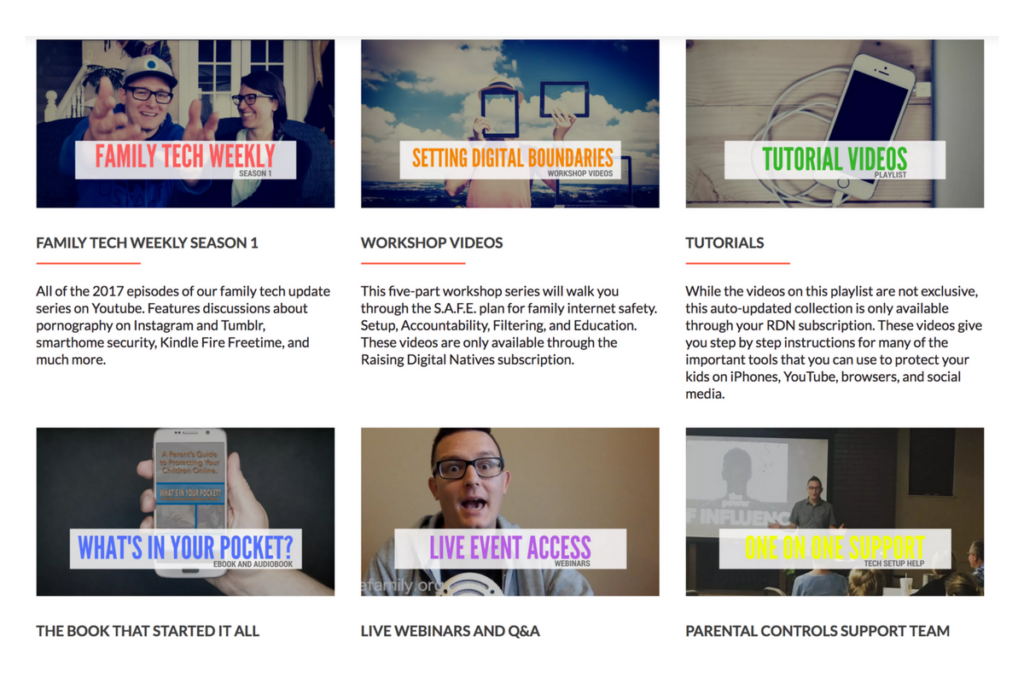
    Raising Digital Natives is a “masterclass” of family internet safety. The point is to give parents more than just inspiration and basic social media and tech news but to continually educate them on what they can do to protect their kids online. This exclusive content will include past seasons of our podcasts, tutorial videos, live workshop events, live Q&A sessions, and one on one parental control support opportunities. The tools included in Raising Digital Natives will give parents a major advantage to raising kids in this digital culture we’re living in. The live workshops will feature topics such as, “What is a digital native?” “Sexualization and the internet,”Legal ramifications of sexting,” and “Keeping them safe when they’re away.”  Workshops will be done online and archived in the member’s section of the website so geography and schedule won’t hinder parents’ ability to learn. Membership costs $4.99 per month and gives 12 months worth of access to anyone who users share their password with.

    What are you waiting for?

    Content is already available and live meetings begin at the end of January (2018.) Go to BecauseFamily.org/rdn to learn more and to sign up. BecauseFamily is the non-profit that is responsible for all the content of FamilyTechBlog.com.

  • Family Safe Eclipse Coverage

    Family Safe Eclipse Coverage

    Everyone has an idea of how you should safely view today’s eclipse. Use the glasses, don’t use the glasses, use a pinhole projector (we’ve made ours) watch live coverage. However you want to view the eclipse in person, you need to know a few things before choosing which live stream coverage you’re wanting to use. For some reason, those who cover events like the eclipse aren’t always scientists or educators and they may give dumb, or even dangerous advice. They might even have non-age appropriate language or other content in their videos, coverage, or advertising. Here are a few of the channels and videos that we recommend so that you can learn about and enjoy live coverage of today’s total eclipse.

    Live Feed

    NASA: 

    I’m only listing this one option. They have a pre-show with more science facts than you can handle and then live coverage from multiple parts of the country. You know the information and advice will be good because these are some of our country’s absolute best scientists. Enjoy!

    Education:

    National Geographic: https://youtu.be/cxrLRbkOwKs

    Some great educational videos about the eclipse and other science facts. National Geographic is a trusted source for nature and science information and education.

    Sci Show Kids: https://www.youtube.com/channel/UCRFIPG2u1DxKLNuE3y2SjHA

    Sci Show Kids is a great way to teach your kids any scientific information. They have some very good videos about today’s eclipse.

    Sci Show Space: https://www.youtube.com/user/scishowspace/search?query=eclipse

    Sci Show Space has great scientific learning videos as well and is perfect for those who are a bit older. The link above is to a search for the eclipse videos on their channel.


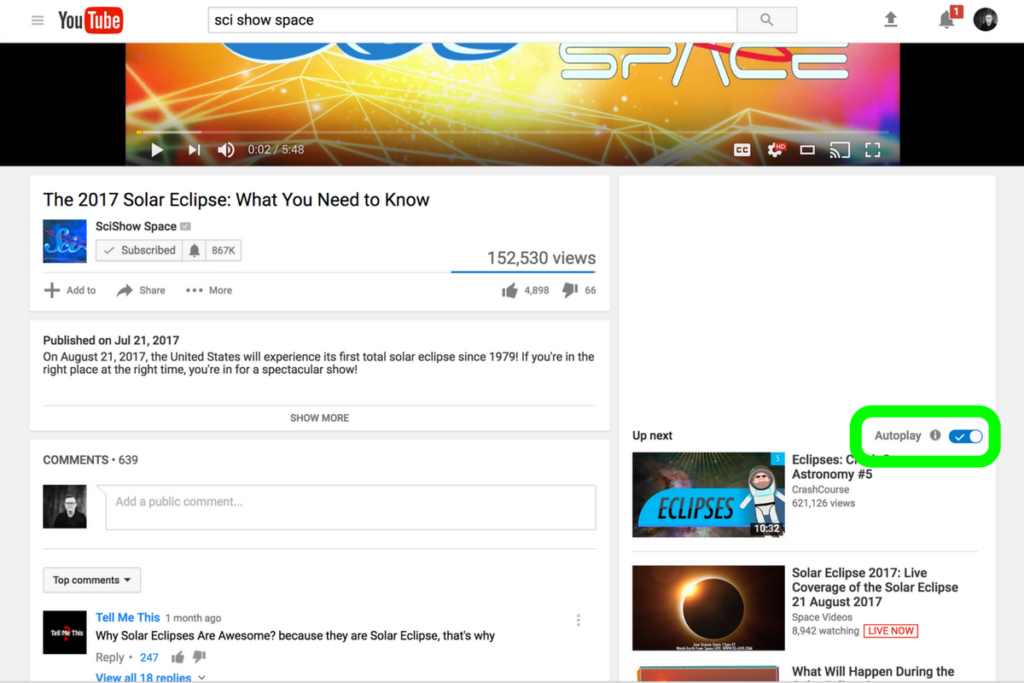
    Be smart about what videos you show your kids and whether or not you allow follow-up videos to autoplay. Turn autoplay off to avoid accidentally exposing them to content you didn’t expect and aren’t ready for them to see. The eclipse is a great opportunity to teach your children some science facts but you have to be wise with what tools you use. Hopefully, the resources listed in this article will give you an idea of where to start. Be safe, and have fun.

  • Adolescent Neuroscience and Online Safety

    Adolescent Neuroscience and Online Safety

    You hear it all the time. “Kid’s these days.” or “I just don’t get teenagers.” There’s a myth that our teenagers are becoming more and more selfish and entitled. In reality, however, adolescence is nothing new. William Shakespeare wrote of the craziness of the teen years in The Winters Tale,

    I would there were no age between ten and three-and-twenty, or that youth would sleep out the rest; for there is nothing in the between but getting wenches with child, wronging the ancientry, stealing, fighting.

    Teenagers of “the good ol’ days,” while they may have had jobs earlier in life or were thrown into battle before they could legally buy a beer, were still teenagers and dealt with the same issues as our kids do these days. The issues may be highlighted these days by the availability of technology and the hyper-connectedness of our culture. Young people have the entire world at their fingertips and can have face to face type interactions with anyone from anywhere. This is what is new and some recent studies in neuroscience have shed light on some of the biological reasons for a teen’s selfishness, risk taking, and lack of self control. Watch this Ted Talk from neuroscientist Sarah Jayne Blackmore.


    What Parents Should Know

    You, most of all, should be encouraged that your teen is just like every other teen. Their outbursts and seeming lack of responsibility is largely based on biological reasons. They aren’t stupid or handicapped, they are developing and this affects their behavior, especially online. A book by David Walsh called Why Do They Act That Way? reminds parents of the “use it of lose it” factor of brain development.

    During development your brain synapses are growing and they literally have to connect to each other in order for you to learn something. During the development of adolescence if you are not guided into proper choices the synapses in your brain will never connect. This means you could struggle with those types of decisions for the rest of your life. With the advent of social media and our dependency on screens for entertainment this necessity for guidance in healthy behaviour is even more evident.

    When your son or daughter tells you that they want a smart phone because all the other kids have one, this is an opportunity to help their brain develop a proper attitude. When your 13-year-old son has been watching YouTube videos for six hours a day setting time limits on your Wi-Fi is helping him practice self-control. When your daughter received a message from somebody she doesn’t know and you see it on your monitoring app and immediately tell her to block that person you’re teaching her how to make good decisions.

    Let this post encourage you. You are the mom or dad, and it’s up to you to help your young adult grow to be a contributing member of society. Their biology can get in the way but your guidance can show them how to make the right decisions. Hang in there, keep doing the hard stuff, we’ll keep giving you the info you need.