Category: Video

  • A Parents’ Guide to Among Us

    A Parents’ Guide to Among Us

    This is a Parents’ Guide to Among Us
    This guide is intended to inform parents to help them make quality decisions for their families. The rating is based on my opinion of playing Among Us and viewing others playing the game as well.

    The rating below is based on the game content. Online interactions will always increase the risk of unwanted content.

    Violence – 3
    Language – 4
    Sexual Content – 5
    Positive Message – 2
    Monetization -2

    Total Score – 16  out of 25
    (The higher the rating, the safer the game is for kids.)

    ESRB Rating – Among Us has an ESRB rating of 10+. It is rated 9+ in the app stores and Common Sense Media gives it a rating of 10+.

    About the Game

    Among Us is an online multiplayer game of social deduction, teamwork, and betrayal. You play as crewmates on a space ship or space station who are trying to prepare the ship for take off. You have tasks that you all must complete to win the game. The catch is that there is an imposter Among Us. This (or these) imposter(s) can sabotage your efforts to prepare your ship, they can also kill you or your crewmates. When a dead body is found, a meeting is called. The entire crew discusses what has happened and what they’ve seen that could give hints as to who the imposter is. They then all vote and if someone gets a majority of votes, they are ejected from the ship. If that person was an imposter, the crew wins, otherwise, it’s back to the ship to complete your tasks and hope the imposter doesn’t get to you first.

    This game has a little bit of everything. There are simple puzzles, social interactions, mystery, and even some opportunity to be a little dark by killing your friends in-game. The graphics are simple and a bit silly, but the gameplay is so fun that it doesn’t matter. This is truly a social game and cannot be played on your own. There is a “freeplay” mode in which you can explore the map and get familiar with puzzles but it is really just for preparing to play online multiplayer.

    Violence

    One of the key themes in Among Us is murder. The imposter is trying to sabotage the ship by whatever means necessary. This usually includes killing crew members. You kill by simply tapping or clicking an icon when you’re close enough to a crewmate. There is then a short animation of your murder. Sometimes you slice them in half, sometimes your small companion (in-game purchase) will shoot them, and sometimes a spear-like tongue will come from you and pierce them in the face. While the animations are a bit graphic, they aren’t really bloody or gory, and they very cartoon/silly. The characters don’t look like humans, they are better described as colorful walking spacesuits so when they are killed, there isn’t much realism.

    Language

    There is no dialog or narration in Among Us. This means that there is no adult language in the game itself. This is a game, however, that is meant to be played with other people over the internet. When you play a multiplayer game online you are always opening yourself up to unsavory language. In Among Us, this happens in the chat which is used to discuss murders and vote out crewmates. There is a censor mode that is on by default. This censor will use symbols to block out adult language and other inappropriate comments. This doesn’t mean that players don’t use these words. You’ll often see sentences with words asterisked out and most of us can tell by the number of symbols and the context of the sentence what words were meant. It is nice that a censor is included and on by default, it is simple to deactivate with one click/tap and is not password protected.

    Sexual Content

    Again, there is no sexual content in Among Us. The style of the game doesn’t lend itself to that kind of material. This is another issue, however, that is greatly impacted by online play. While the censor mentioned above will block some sexual comments, most make it through. While playing the game I saw many players with suggestive usernames. Nothing obvious but definitely innuendo. When these names were commented on in chat, however, they were mostly met with annoyance by other players who just wanted to play the game and were therefore not amused.

    In other words, there will always be people who think their immature sexual jokes and comments are funny but in such a social game you’ll also find a majority of players who aren’t interested in that kind of humor. These players usually kick out or shut down the inappropriate players pretty quickly.

    Positive Message

    I guess we can talk about teamwork and trust here but in reality, this game is just all about having fun. There is no real moral to Among Us, it is intended to be a clone of the classic party game Mafia but set in space. Playing with friends is easy through their local or private game settings and this allows for kids to have fun with friends even though we can’t be around each other all of the time these days. I think this is what made Among Us the breakout game of 2020 even though it has already been released for two years.

    Monetization

    Among Us does have in-game purchases but they aren’t game-changing. You can buy packs of costumes, skins, and even pets. The prices are between $1 and $3 per pack and the game is definitely playable without spending more than the $4.99 it cost on the PC. The mobile version (free for Apple and Android) has ads that can be removed for $1.99. I recommend removing these ads because some of the games advertised should, in my opinion, be rated for adults only.

    What Parents Should Know

    Among Us is a game that I have been playing quite often lately. It is easy to pop in and do a ten or fifteen minute round and then log off. I have played in public rooms with friends as well, that was quite fun as we were able to work together (trying not to cheat) to complete tasks and win. It can be a time drainer as you always want to play another round. I find myself saying “one more round” a few times before I actually quit the game. Like Fortnite or other online multiplayer games, kids aren’t going to want to drop out in the middle of a game so giving them a warning about getting off their screen will be better than saying, “Put it away, now!” Trust me, you’ll have less conflict if you say “Be finished after this round, alright?” and then hold them to that.

    The only real danger in this game is from strangers online. While that is always a concern with online multiplayer games, rounds are so short and fast-paced in Among Us that there isn’t much time for “grooming” or bullying especially since there is no private or direct messaging. You can stay in the same “Lobby” to play with the same people but it is so easy to back out and go into another game if you need to that I wouldn’t expect too much trouble from people in chat in Among Us.

    As with most games, my recommendation is that parents understand Among Us, how it works, and what their kids like about it. Know who they are playing with online and if they are playing with strangers, be sure they feel comfortable coming to you if they see something that makes them feel strange. This game is simple enough and quick enough that many parents should be able to play along with their kids some as well. Do this. It would be really fun for you to get into their world a little bit, plus you may just enjoy the game yourself.

  • The Family Tech CES2020 Preview

    The Family Tech CES2020 Preview

    Every year at CES, tens of thousands of people gather to see the latest that technology has to offer. Every tech media outlet covers CES. They’ll be talking about everything from virtual reality to massage chairs. This is your Family Tech CES2020 preview. There are a lot of interesting topics being covered at CES this year. Here are some that I think are the most interesting and some that are specifically important for families like yours.


    TV Talk

    Welcome to the age of the 8K television. That’s right, we’ve skipped from 4k resolution to the mind bendingly clear 8k quality. Some say that the human eye can’t even discern that kind of clarity but it sure would be fun to find our for ourselves. The 8k tvs from LG, Samsung, and Sony tout such amazing tech that you need a screen larger that 65 inches to even get the full benefit.

    Voice-Enabled Digital Assistants on Everything

    Voice assistants are in everything. It’s in your car, your TV remote, even your toilet and shower. That is going to continue at CES 2020. Look to find voice activated technology in more and more gadgets this year. Even our kids are being offered toys and gadgets with voice command tech built in. Voice Assistants aren’t new but seeing them integrated into everything else only proves that this concept is here to stay.

    foldable phones family tech ces2020 preview

    Crazy New Gadgets

    There is always some crazy stuff at CES. Some is pretty unimportant but interesting. Some things are said to be the new face of technology but just seem strange to me. Foldable phones fit into that category, so do many of the robot offerings at the conference. Either way I’ll be looking for the most amusing and interesting gadgets to show you at this year’s CES.

    5G Technology

    5G is a bit of a buzz phrase these days but there is some actual technology behind the term. This fast, “over the air,” data connection is finally starting to spread for real. Many major cities are adding 5G to their infrastructure. It’s expensive and coverage is spotty but wherever it works, it’s lightning fast. The reason 5G is so critical is the role it will play in the roll out of self driving car technology. The connection speed that 5G offers is critical to the success of the self driving revolution.

    Self Driving Car Technology

    Self Driving Cars are always the bell of the ball at CES. This year will be no different with more and more companies finding ways to implement the improving technology. Not only are the cars themselves a big deal but the tech around mapping, connection speed, and entertainment inside your self driving car is becoming a major reality as well. It isn’t easy to hitch a ride in one of these vehicles at CES but I’m going to try my hardest this year.


    What Parents Should Know

    The future of technology is always going to include products to entice our children. Coding toys, games, gadgets, and safety tech are all being highlighted at CES2020 and I’ll be there to show you what to look out for and what to look forward to. As I look toward this year’s conference, here is a family tech preview of CES2020.

    Ed-Tech

    As highlighted last year, education technology is a going to be all over the show floor at CES. I’ll show your new coding games and toys as well as virtual and augmented reality classrooms. Robots will play a major role in training students for future technology jobs as well. Keep your browser open to the Family Tech Blog to see more as the conference starts up next week.

    pet tech family tech ces2020 preview

    Pet-Tech

    The furry members of our family have a place at CES as well. Dog toilets, cat toys that move across the ground, connected leashes, and even fenceless boundaries highlight the pet tech industry at CES. You’d be surprised how much tech can help people care for their pets and help pets care for their people. You probably wouldn’t be surprised, however, at some of the goofy pet tech that shows up at CES as well.

    Smart-home/ Home Security

    Everyone’s homes are becoming smarter and smarter, even if the way we use the technology isn’t so wise. Technology that can keep our home network and connected devices safe is crucial and thus, a major factor at CES. I’ll be spending quite a bit of time chatting with developers about their products intended to keep your data secure. Some even offer new parental control solutions as well.

    Connected Toys

    So many of our toys are connected to the internet now. Games, robots, even racetracks are finding ways to connect your tablet or smartphone. You are given an online account in order to fully play with these toys. This is introducing our kids to use of the internet earlier and earlier. What products are coming up that feature connected toys? I’ll gave updated information for you from CES next week.

    Avast All-in-One Security and Safety – Omni

    I’m very excited to test out one specific piece of family safety technology. Avast’s Omni device is an all-in-one way to protect your network from hackers, malware, spyware, viruses, and even set up parental controls and GPS alerts. I’m excited to have a hands on look at Omni while I visit their booth at CES. I’ll also be able to hear from their VP of Product Deliver as she shares at the Family Tech Summit on Thursday of the conference.

    A Long Six Days

    Hope you enjoyed this family tech CES2020 preview. This event is a lot of work and makes for long days. It is, however, some of the most useful and rewarding work I do all year. The new tech, updates on the latest trends, and marketing strategy research gives me such great information to pass along to you, parents. Thank you to those who have partnered with BecauseFamily for this trip to Las Vegas. If you would like to partner with our organization just visit our Partnership page. You can follow every detail of my adventure to CES2020 on our Facebook Page, our Instagram, and on YouTube. Thank you again, see you soon, from Vegas!

  • YouTube’s Children Privacy Policies Causing Content Creators to be More Crude in their Videos

    YouTube’s Children Privacy Policies Causing Content Creators to be More Crude in their Videos


    I am an avid YouTube viewer. I get most of my entertainment from the video streaming service, watching gaming videos, D&D streams, and educational tutorials. I have noticed a trend since YouTube changed its policies for creators to be more responsible for their channel’s content as it pertains to advertising to children. 

    Since YouTube cannot collect viewer data from videos that are intended for children, the company has asked creators to label whether their videos are for kids or not. They are also using an algorithm to view popular videos and identify the content as meant for kids or not meant for kids. This algorithm has content creators concerned for the viability of their channel. This has caused them to be more blatant with crude content and swearing in order to make it very obvious to this algorithm that their video is not meant for children.

    One YouTuber that I enjoy watching, partially because he isn’t overly crude, has been starting his videos with strings of swear words and jokingly saying “This video isn’t for kids YouTube, just be aware, not meant for children.” One of the reasons he feels the need to say this so blatantly is because he plays video games on his channel that may appeal to children. The images of the game alone could lead a person or artificial intelligent software to believe the video was made for children even though that isn’t this creator’s main target audience. Another YouTube content creator that I know has lamented on social media that his channel, which is family-friendly, has lost hundreds of dollars monthly in revenue since YouTube changed their policies. 

    SirWillow is a Family-Friendly YouTube Channel with nearly 30,000 subscribers and over 4 and a half million views.

    1. Would you be willing to tell me a percentage your ad revenue went down when YouTube changed their policies?

    I’m still waiting to see how it all sorts out, but right now in my case I’m looking at about a 30% drop, but it’s in a state of flux. What will be telling will be the end of January when the full force of the new policies kicks in.

    1. How have the changes to the ad policy changed your process for making videos?

    In my case, it hasn’t changed any of my process.  But I may not be the norm in that regard. I know several that do YouTube “full time” and for them, it has meant some drastic changes.  I know at least one that is likely going to shut down, another is cutting back on YouTube to increase time in other projects. For me, it’s been a hobby that has brought in a part-time job income, and while the income has dropped it’s still going to fit the same role.  It has meant a change in how many videos though. I am cutting back my production some from 10-12 videos a month to closer to 7.

    1. Your videos are “family-friendly.” Do you think that YouTube is becoming a less friendly place for families in general or is it mostly up to creators?

    I absolutely think YouTube is becoming less family-friendly, and these changes are going to directly impact that and make it worse.  The changes are going to pretty much destroy financial benefits for anyone producing kid-focused videos, and there are a lot of family-friendly channels that are going to get caught in that backwash and cut back or stop producing. It’s also going to be harder to find kid and family-friendly videos because of all of the blocks that will remove them from the normal algorithms that recommend videos.

    And there are a number of producers who have, as you mentioned, increased cursing and crude language, along with images and subjects to make it clear that they aren’t “kid-focused”  It’s going to make it hard to find, and hard to produce and make money, kid and family-friendly content.

    My thanks to SirWillow for answering these questions for me. He does videos about theme parks and what it has been like working at theme parks. Go check out his channel!

    What Parents Should Know

    It should be very clear by now that YouTube isn’t intended for children. It is becoming harder and harder for people who make videos for kids to sustain a profitable channel on the site. This is causing some different reactions. Some kids’ channels are switching to a subscription method where you can sign up to pay monthly for more content from them. Others are changing to Facebook or Twitch because of their less strict ad policies. 

    The only real way to be sure your kids aren’t watching videos that aren’t intended for their age is for you to control what they are viewing. Legally, our young kids (under 13) are supposed to be using only apps intended for their age group. The legal responsibility, however, doesn’t fall to our kids or even us as their parents, it falls to the company. Hundreds of millions of dollars worth of fines have been handed out by the FTC for companies illegally collecting data from children. They are being investigated and forced to make changes. The changes seem like they should be good for the safety of our children but so far they are only truly helping protect the company from the repercussions of disobeying child safety laws.

    When the safety measures protect only from advertising info being collected, they may be intended to protect children but in practice, they seem to be increasing the volatility of the content on the service while only protecting the service itself. Parents are the only true guardians of our kids’ hearts and minds. The only way to protect them from adult content and crude language on the videos they watch are to take responsibility for their screen time ourselves. Here are some tips:

    • Only allow screens in a public area. 
    • Limit headphone use so you can hear what they are watching.
    • Build playlists on YouTube to ensure they are only watching videos meant for kids.
    • Use apps like PBS Kids or DisneyPlus to keep them watching family-friendly videos.
    • Use YouTube kids instead of YouTube; while not foolproof its a far better option than basic YouTube. 
    • Limit the amount of time watching videos; the more time spent on YouTube the more chance of coming across inappropriate content.

    Parents should take the steps necessary to protect their children online. Companies should be held responsible for their advertising practices and the content on their sites and apps but the responsibility for protecting our children falls strictly to parents. When the measure taken by companies to protect kids backfire by causing creators to lose money unless they swear, use violent and sexist language, or show adult images on their videos, the measure don’t protect our kids, they make the app more dangerous. Parents are the gatekeeper. Protect your children. 

  • Be S.A.F.E. Online During the Holidays

    Be S.A.F.E. Online During the Holidays

    **This post is an updated version of an article from 2017. 

    The Holidays are a time of fun, family, faith, and food. Everyone coming together can be super fun for the entire family. There can also be some struggles here and there, especially when it comes to what shows up on the screens in the house. Your younger kids could end up seeing too much social media on their teenage cousin’s smartphone. Uncle so and so can show Youtube videos to some family with adult language and content not noticing the children in the room. Heres a few tips to try and keep your Holiday internet safe and family friendly.

    Protect Your Kids

    Encourage a host home internet filter.

    Ask the family member or friend who’s hosting your festivities if they have some sort of content filter on their wifi. Many routers have a basic filter and some folks may even have another filter system in place. If there isn’t an option, recommend one like Circle. If they don’t have kids or aren’t interested in filtering their wifi long term you can recommend a free trial with something like Mobicip or NetNanny. This usually allows you to use the filter for seven days to a month at no cost. Offer to help them set it up and then you can breathe a little easier when your kids are using their wifi.

    Keep devices with screens in a common area.

    Intentional poor behavior will happen in private. If you keep the screens around everyone else you’re much less likely to have an incident. Make a rule that screens should be kept in the most common area of your Thanksgiving meeting place. The living room full of people or the dining room around a busy table is a great place to let kids spend whatever time on screens you’ve allowed while adult eyes can glance down to see what’s being viewed. This will also keep sneaky cousins from pulling up something age appropriate for their younger family members.

    Talk to your kids.

    Your kids need a safe place. They need to know that if they see something inappropriate online they can come to you and receive no judgment or criticism.  It’s critical that they are allowed to explain what they saw and how it made them feel. Discuss your screen boundaries ahead of time, your kids should know what you expect even if you aren’t able to get the whole extended family onboard with your plan. Tell them if you want them staying off screens completely. Let them know not to look at older kid’s phones or tablets while they play. Think ahead of the likelihood of your kid seeing something they shouldn’t and try to head that off at the pass. Accidents happen but if you and your kids are on guard, you should be able to have fun without too much worry.

    Protect Your Privacy

    Turn off camera location settings.

    Your camera defaults to save your location every time you take a photo. This tags those photos with where you were when you snapped that pic. Then, when you share the image on Instagram, Facebook, or Snapchat your location is uploaded with the image. This means that with the right software your location can be extracted from that photo and used for unseemly reasons. 

    • Go into your settings app and access your “location” settings.
    • Go to the camera app settings under “location” and tell your phone never to use “location” while using your camera.

    Changing these settings will keep your location data off of your pictures.

    Advise family members not to tag their location on their Holiday posts.

    Finally, you’ll want to be careful not to tag your location on your photos. Yes, pictures of the pie, stuffing, turkey, and gravy boat have become as much a part of the holiday tradition as the cornucopia, but when you share it you’ll want to leave the address of the host off of your status update. Sharing your address with public social media posts is never a good idea. This can lead to all kinds of dangers. Imagine the images of all the neat and expensive stuff in the host home. Now imagine you’re a local who likes to break and enter to take things every now and then. What better way to identify a target than creep Instagram holiday posts for the people with the coolest stuff. Then, find the posts with their address tagged on the photo and off you go. Share away, but share with wisdom.

    The holidays should be a time of rejoicing and happiness. We should stuff ourselves with food and enjoy being together. Following these steps can help you stay safe and help keep your holiday party guests safe as well. 

  • UPDATED: YouTube May Eliminate Targeted Ads on Kids’ Videos

    UPDATED: YouTube May Eliminate Targeted Ads on Kids’ Videos

    UPDATE 9-4-2019: This morning the FTC announced a 170 million dollar settlement with Google to end the investivations  of YouTube’s children’s data collection practices. At the same time YouTube announced they are rolling out funding for original children programming. YouTube CEO, Susan Wojcicki said that the changes proposed by the FTC could be detrimental to much of the ad revenue made by content creators who make videos targeting children. She also said that the changes are rolling out slowly over four months to give creators time to adjust their content.

    Child data security advocates are not satisfied with this fine or these changes. They were hoping for more:

    “A plethora of parental concerns about YouTube – from inappropriate content and recommendations to excessive screen time – can all be traced to Google’s business model of using data to maximize watch time and ad revenue,” said Josh Golin, the Executive Director for the Campaign for a Commercial-Free Childhood (CCFC).

    Parents should be aware that the changes to YouTube’s data collection and advertising properties are rolling out slowly but will affect both YouTube and YouTube kids. My advice as mentioned in the video below, is that parents pay close attention to the videos their children watch on YouTube. Understand that much of the content they consume is created to advertise products whether it be websites, video games, or physical products such as toys or food and candy. Advertisments will still be geared toward kids based on the videos they are choosing to watch, much like seeing commercials for toys during Saturday morning cartoons.

    8-23-2019

    YouTube’s data collection policies have garnered attention from media and government agencies alike over the past several months. After some shocking reports about child pornography on the site and restrictions handed down from the FTC, Google is finally taking some real steps to comply with the Child Online Privacy Protection Act (COPPA.) Bloomberg reported this week that YouTube will be ending targeted ads on videos intended for children. 

    Obviously, ads that target viewers use data that has been collected in order to assign advertisement to that user. If YouTube is targeting ads to children, it stands to reason that they are collecting information about them as viewers in order to create their advertising profile in the first place. This data collection is blatantly against COPPA and one of the reasons the site was investigated by the FTC earlier this year.

    YouTube has already cut advertising income from videos that feature disturbing content aimed at children and eliminated comments in videos that feature children. It is estimated that YouTube makes nearly $750m annually from advertising on children’s videos. Obviously eliminating those targeted ads could seriously hurt Google’s bottom line but they say it is the least damaging option. There are other ways for YouTube to serve somewhat targeted ads to children. The company can use ads that are chosen based on the videos they appear on, thus tying the kids’ interest in the video itself with the ad that will be served. Those who have brought complaints against YouTube about their COPPA violations aren’t expected to be satisfied with that solution either.

    The Best Way to Keep Your Kids Safe On Youtube

    What Parents Should Know

    Of course YouTube wants your children to use YouTube Kids. This is how they protect themselves from the very mess they are in now. They say that YouTube Kids doesn’t collect data from viewers and only shows ads as they relate to the video users are watching. Even so, my recommendation is that your kids only watch YouTube in a place that everyone can see what they are watching. If inappropriate content comes up you will want to see what it is. This way you can talk to your child about what they saw and how to avoid seeing that in the first place.

    Another option is to use YouTube Premium to eliminate ads all together. We use this so that when we build a playlist of videos for our kids, we can be sure that they’ll only see what we selected and not some other video ad for something we may not approve of. YouTube is trying all they can to keep their ad based ecosystem alive while staying out of dangerous apps list and tech safety expert blog posts. Only time will tell if they are able to do so. This change could be a very tiny step in the right direction. 

  • “Ninja” Moves Gaming Stream to MIXER and Twitch Shows Porn on His Channel

    “Ninja” Moves Gaming Stream to MIXER and Twitch Shows Porn on His Channel

    Ninja (Tyler Blevins) switched his streaming content over to Microsoft run “Mixer” on August 1st and has been migrating his viewers over to the service over the past couple of weeks. He took to Twitter to express his disgust over the fact that Twitch was running ads for other streamers on his channel’s landing page. The disgust didn’t stop there though, somehow a channel that was showing hardcore pornography was featured on Ninja’s page and this made him understandably upset. Again, Ninja posted about his frustration on Twitter and the CEO of Twitch was quick to apologize.

    There is a lot of discussion in the gaming and streaming world about who owns the channels that streamers use to broadcast and who should be able to decide what is aired on the channel when the streamer isn’t live. Obviously, this affects you, as a parent in several different ways. First of all, your kids are likely going to be watching Ninja over on Mixer now. Secondly, you need to know that pornography can show up on these live streaming services very easily. You also should be aware of the money and politics currently involved in the video game streaming industry. It’s a major business now, and your kids are the target consumer.

    What is Mixer?

    Mixer started out as “Beam,” a streaming platform that claimed to offer a better service and higher quality streaming ability that competitor Twitch. In 2016 Beam was purchased by Microsoft and in 2017 Beam was rebranded as Mixer. The service still works to compete against Twitch but claims to offer a better ad share program to gamers as well as a better viewing experience for fans. The service has already made a few deals with pro-gaming leagues and now has acquired Ninja as an exclusive streamer on their platform. Just like Twitch, Mixer offers multiple types of streams including video gaming, tabletop gaming, vloggers, IRL (in real life), podcasts and more.

    Ok, Fine. Here’s What I Think About Fortnite


    Since being purchased by Microsoft, Mixer is now available on Xbox, and on Chromecast and other streaming devices. It is becoming more and more popular and Ninja’s exclusive contract will guarantee even more growth. Twitch is suffering the same fate that many market leaders share. It can be difficult to balance making the kind of profit that a company that size needs to operate and keeping the same charm that your service had when it gained all of the popularity that you profit from. It seems that there is room in the video game live-streaming market for another service.

    What Parents Should Know

    Video game streaming and esports are some of the fastest growing forms of entertainment ever. Advertisers are jumping on board and monetizing every minute your kids spend watching other people play video games. When you think about it, the video itself is a form of product placement for the game they are playing. When advertisers get involved, things often get messy. Content creators get tired of their media being turned into a way for someone else to make money. This makes them go look for a better deal. This is what has happened with Ninja.

    You need to be aware that when people broadcast on live-streaming services there is usually a live chat going at the same time. Your kids can be in contact with strangers from all over the world. Also, it is very difficult to keep inappropriate content off of live streaming channels due to the fact that is being broadcasted in near real time. You should know what your kids enjoy watching on Mixer, Twitch, YouTube Live, and any other live-streaming platforms they watch. Know that many gamers use adult language and discuss adult topics on their streams. Most of the time those apps are rated 17+ because of the potential for adult content. Keep that in mind when deciding what you allow your child to watch online.

  • Is Apple Blocking Parental Control Apps Because they are Competitors to Screen Time?

    Is Apple Blocking Parental Control Apps Because they are Competitors to Screen Time?

    The Story So Far

    It is a long and arduous story, the tale of Apple shutting down parental control apps. Some say it was done to protect Apple’s investment in their own Screen Time app while others believe Apple truly has the wellbeing of their customers at heart. It is hard to look at this story from any one angle alone without making a blanket statement about the opposing side. This is why I have taken a look at all sides and wish to help you, parents, understand what is happening in this strange new war.

    Last fall, after announcing the release of iOS 12 which feature their new controls app “Screen Time,” Apple began to deny certain parental control apps access to the app store. Apparently, citing the fact that Apple doesn’t allow apps to use any method to block other apps (a pretty important feature in a parental control software.) Eleven of the top seventeen parental control app developers such as Mobicip, OurPact (the top Parental Control app in the app store,) and Quistudo were all in communications with Apple for months about their apps being removed and what it would take to get reinstated. Apple’s comments seem to have been centered mostly around the removal of apps and the use of something called MDM or Mobile Device Management. They stand on the fact that MDM allows access to information that should remain private. Developers of the Parental Control apps are saying that Apple said nothing about privacy in any of their communication about getting their apps reinstated. This is causing a bit of concern for developers, media, and parents alike.

    Even more information about MDM in the video and podcast.

    Recently, the New York Times released an article about Apple’s removal of the parental control apps from the app store alluding to the possibility that the move was to eliminate competition for Apple’s Screen Time or even to keep people from using apps that cause them to use the iPhones less often. We are obviously getting a lot of they said/they said back and forth with this story and there is more to come (law suits and such) but here is what I think it all means for parents. 

    What Parents Should Know

    Above all it is important for parents to understand that there is no such thing as the perfect parental control app. The free ones are likely selling your data and the paid apps are usually using some sort of loophole to even work properly. Apple uses a pretty closed approach to their app store, only allowing a very small “sandbox” for developers to work in. This causes many of the parental apps in question to fall short of complete and total control. The MDM allowed for a bit more of that control but without that access, many of these apps are simply useless. I do believe that parental control apps should be held responsible for what they do with the data that they collect. Apple takes data security and privacy very seriously. This is what they have said is at the core of their stance against some of these apps. Apple must protect the privacy of their users, it is a major part of their platform and what sets them apart from their competitors.

    Time Management Dashboard Coming to Instagram and Facebook

    What does this mean for us as parents who want to protect our kids? First of all we have to remain vigilant to keep our kids safe online. Use some sort of network level parental controls. Whether you use Circle or something else that is built in to your router, it is a lot easier to set up filters that block your entire network than to set it up on each device. Also, you can just learn and use the built in parental controls that Apple and Android have created. Screen Time isn’t perfect (as I said, none are) but it is pretty good. Use the resources you have as well as a good, healthy environment of conversation and security to keep your kids using tech properly and discussing it with you regularly.

    Until Apple makes it easier for software developers to access user behavior, any built in parental control options will be bettor for iPhone and iPad users. Screen Time is currently a bit limited but is is a lot better than nothing and will work for most families. The best part is that the stance Apple has taken for privacy will also apply to users who have set up Screen Time. Any account that you have set up for your child will be treated as a child’s account and Apple’s terms state that their data will be treated as such also. Maybe your favorite Parental Control app is a part of this whole drama. If so, hang in there and set up something you can use because this whole story isn’t over. I’ll keep you updated as more happens.

    For even more, listen to the podcast episode below:

  • Facebook is Making a Dating Feature while Instagram Works to Curb Bullying

    Facebook is Making a Dating Feature while Instagram Works to Curb Bullying

    Social Media News from Facebook’s F8 Conference

    The F8 Developers Conference is Facebook’s annual event to showcase what they are working on in their numerous social media and messaging platforms. Tuesday’s announcements featured Facebook’s new features to connect people for romance and new friendships. Instagram is looking to stop bullying before it happens.

    Facebook Dating

    The dating feature for Facebook has been tested in several countries including Mexico, Thailand, and Canada. It will be rolled out soon to more countries and finally released in the United States “by the end of this year.The latest update to Facebook Dating allows you to build a secret crush list. This list of eight people will be saved and compared to the lists of your friends who also use Facebook Dating. If any of your crushes add you to their crush list you will both be notified so you can make a connection.

    I guess, if you’re going to try to make romantic connections on social media it is better to start with people you’re already friends with. Facebook says it will help you with connections based on your groups, likes, and comments on their app. Their goal is to help connect you to people with whom you share interested, thus, increasing the chance of you having a match. They actually said they are not trying to make connections for a one time hook up but to actually help you find someone you’d be interested in having a real relationship with.

    Facebook is also testing features that will recommend new friends based on your interests, location, work, and even what college you went to. Again, being tested in just a few countries, the Meet New Friends feature will allow users to opt-in and then customize their profile to tell the system what interests to prioritize while connecting them with new friends. You can even list what activities you’d like to do with new friends and then be prompted to send a private message to someone and make plans to do that activity.

    What Parents Should Know

    Fewer of our kids use Facebook now but there are those that still spend time on there. Dating and Friend Finding features can be problematic for parents who are concerned about their kids making unwanted connections on social media. My advice is to not allow your child on social media until around the age of 16 (based on their maturity) and even then keep open conversation with them about the kind of people they make friends with online. My rule will be to only allow my friends to communicate online with people they already know really well in real life.

    Instagram Fights Bullying

    While Facebook is trying to connect you with more people, Instagram is working to protect you from the people you’re already connected to. Developers have announced a tool that will nudge users to think twice before posting a negative comment on an Instagram photo. They can choose to ignore the advice and post it anyway, but Instagram is hoping that causing them to give pause will curb some of the negativity that Instagram is becoming known for. There are also tools in development that will allow users to block comments from certain users without blocking their accounts altogether.

    Just in case blocking comments isn’t enough of a break from the negativity, another Instagram feature will let you take a break by going into “away mode.” This is a way to sign off of Instagram for a while, no longer get messages, comments, and notifications or be prompted to post, but still not have to delete your account. Also, in an attempt to make Instagram “less pressurized” they are testing the ability to hide like counts.

    What Parents Should Know

    We have all heard stories of young people deleting or archiving photos because they didn’t get enough likes. We’ve read the horrible news stories about kids who harmed themselves, or worse, as a result of being bullied on Instagram or Snapchat. These efforts by Instagram to curb some of the negativity are a great idea. In my opinion, however, there is no better line of defense that parents. Our job is to create that safe space for our kids to come to when they have a question or concern about social media. We should be the ones determining how old they should be before they sign up for that Instagram profile. We should be who they come to when some stranger reaches out to them on Snapchat. That can’t happen if we aren’t aware or if we are too timid about the time they spend on social media. If we will take our role seriously we can raise kids who are healthy and whole.

    Listen to this post as a podcast below:

  • Indian Agencies Ask for Removal of TikTok from App Stores Citing “Pornographic and Illicit Content.”

    Indian Agencies Ask for Removal of TikTok from App Stores Citing “Pornographic and Illicit Content.”

    The Ministry of Electronics and Information Technology in the country of India has asked Apple and Android to remove Tik Tok from their app stores due to pornographic and other inappropriate content. The statement says that the app encourages illicit content. This comes just months after being fined by America’s Federal Trade Commission for improperly managing data collected from users in their young target audience.

    TikTok, managed by Chinese company Bytedance, has hundreds of millions of users and features user generated lip-sync, livestream, and other short form videos. The app has come under fire from many child protection agencies because of their lack of age verification and limited parental controls. The app is most popular with kids under 20 and mostly with girls. The app is wildly popular with kids under the age of 13 but it isn’t likely that stats will show that demographic since most who sign up say they are over 13 years old to line up with the company’s terms and agreements.

    Tik-Tok Under Fire as Study Finds 25% of Kids Talk to Strangers Online

    What Parents Should Know

    TikTok is another example of user generated content getting away from the company who is supposed to manage that content. They say they are doing all they can and boast how many videos and posts they’ve removed due to violations, all the while more illicit content is being uploaded by new accounts. While these companies play catch up our kids are the ones seeing the inappropriate videos that haven’t been flagged enough yet and being contacted by the creepy predators who’s accounts have yet to be removed. As I often say, the responsibility falls to parents to protect our kids from this content.

    You have to ask what it is, besides the sheer scale of numbers, that makes it so difficult for companies to get a handle on this. These issues continue to flare up yet the companies continue to grow and growth is ultimately the goal. Growth means money. Companies need more users to grow. More content will earn you more users. So perhaps they try to remove as little content as possible because it is easier to ignore the illicit and pay the bills than take a stand to protect your users and possibly slow the growth of your company. 

    Parents have to be aware of what apps their kids use. We should know when they are live-streaming or posting videos of themselves. We should follow their accounts and see what everyone who follows them see. If they won’t allow you to follow them you shouldn’t allow them to use the app. It’s really simple. Tic Tok, Snapchat, Instagram; none of them exist to keep your kids safe, they exist to make money and only take steps toward security and privacy when not doing so may hurt their bottom line. Parents have to stand up, not to these companies, but to our kids, and tell them that our goal is safety and health. Then set the right example and work with them to have the right attitude about our time on social media and other tech. You can do it! We’re here to help you.

    Listen to this article as a podcast below:

  • LETS RESEARCH | Predatory Advertising in Preschooler Apps

    LETS RESEARCH | Predatory Advertising in Preschooler Apps

    The Study

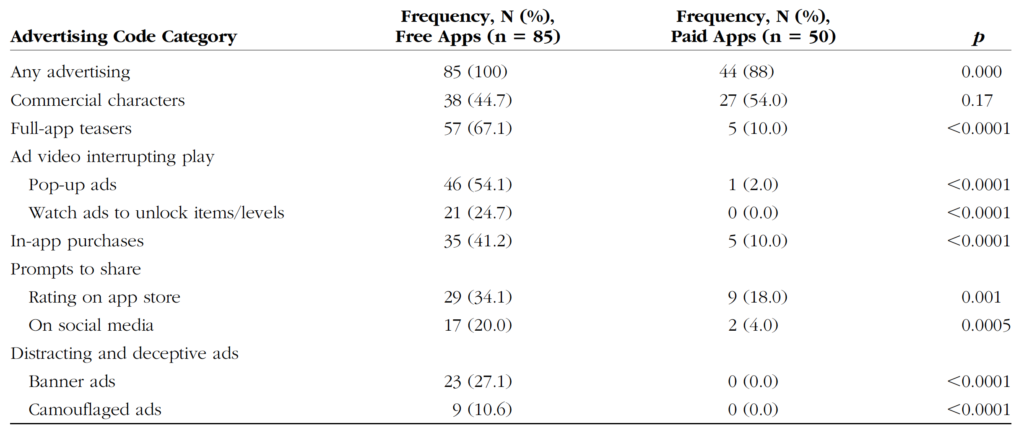
    This review by Wolters Kluwer Health looked at 39 apps that target kids ages 5 and under. They reviewed the different kinds of advertising and manipulation used in the apps to encourage engagement by the young users. Researchers used Android devices and tested the most popular apps in the age category at the time.

    Types of Advertising:

    Commercial Characters – These are apps that are designed around marketing certain characters that your kids may already love. i.e. Daniel Tiger, Mickey Mouse, Bob the Builder, or Hello Kitty.

    App Teasers – Encouragement for kids to unlock the “full version” of the app.

    Ad Videos Interrupting Play – Videos that feature other apps in the marketplace by interrupting your child’s use of the current app and showing videos of gameplay.

    In-App Purchases – Items, levels, or other content that your child can’t use in the app without purchasing them. These may be items that can be used in game, costumes or costume pieces or even in-game currency that can be used to purchase other things in the app.

    Prompts to Share – Encouragement to share the app on social media sites or even just to rate it on the app store.

    Deceptive or Distracting Ads – These ads often trick your child into thinking they are playing another level of the game. Sometimes they look like they are a part of the app your child is using and then open up an app store link when tapped.

    What Parents Should Know

    To get my full thoughts on this research watch the video above. Liking it and sharing with your friends would be super helpful as well. I will say here, though, that it is critical that we as parents understand how these apps are marketing to our children and help our kids understand the difference between something they are playing or learning from and an advertisement. This study also looked at the difference between ads in paid apps vs free apps and educational apps vs entertainment. None of the results are shocking but hopefully, they are a bit eye-opening for parents who allow their kids unsupervised time on screens.