Category: Screen Time

  • Looking Forward to CES 2019

    Looking Forward to CES 2019

    As CES 2019 approaches (my flight leaves in 17 days) I find myself more and more interested in the different topics that will be discussed at the Kids@Play Family Tech Summit. The summit features leaders in the industries of tech, toys, education, psychology, software, and entertainment. Sessions last all day long and the topics discussed are exactly the kind of information we parents need to know as we raise our kids in this digital age. The problem is, those in attendance are all industry people who are making apps, toys, and technology for our kids and families. There is very little to no representation of those who work to educate parents themselves on the connected age we live in. That’s where I come in.

    To my knowledge, BecauseFamily’s FamilyTechBlog, is the only publication in attendance at CES that offers our news and stories exclusively from the viewpoint of helping parents protect their children. While I sit and take notes and record footage of the summit my mind is processing how this information can help parents make quality decisions to keep their kids safe on their tech devices. I am glad that this event exists and happy that leaders in this industry are having serious discussions about how to be responsible while developing their products for children. I am also glad that our donors and readers have made it possible for me to be there, as the only exclusive family tech safety website in attendance, and report back to you.

    Here is some of what I’m looking forward to seeing, learning, and reporting on at CES 2019:

    • Jobs of the Future
    • Coding Without Screens
    • Gaming and Creativity
    • Tech Addiction
    • Data and Privacy for Connected Kid’s Products
    • Augmented and Virtual Reality to Help Kids Get More Active

    There is a ton more that I’m excited to see and learn but these are going to be the highlights for sure. Parents are always asking about things like gaming and tech addiction and the jobs that are available to our children now will be completely different in ten years. Having some insight on these questions will be pivotal to making decisions as parents. Many of us have issues with keeping our kids active as they’d rather play with tech than each other at times. Can the tech increase their activity without impacting them in other negative ways? Finally, coding will soon be a skill that is not optional if you want to have your pick of the jobs of the future. How can we introduce coding logic and principles to our children without exacerbating the screen addiction problems we already see in out kids? I am looking forward to finding answers or at least more insight on these topics and questions at CES 2019.

    You Can Help!

    Very briefly, allow me to ask for your help for this trip to Las Vegas for CES 2019. The costs associated with this event are covered solely by donations from our non-profit partners and donors. If you would like to sponsor a meal, an Uber or Lyft ride, or something like that, please visit BecauseFamily.org/partnership to see how you can donate to BecauseFamily and send your family tech safety representative to CES on your behalf. Thank you.



  • LETS RESEARCH | Predatory Advertising in Preschooler Apps

    LETS RESEARCH | Predatory Advertising in Preschooler Apps

    The Study

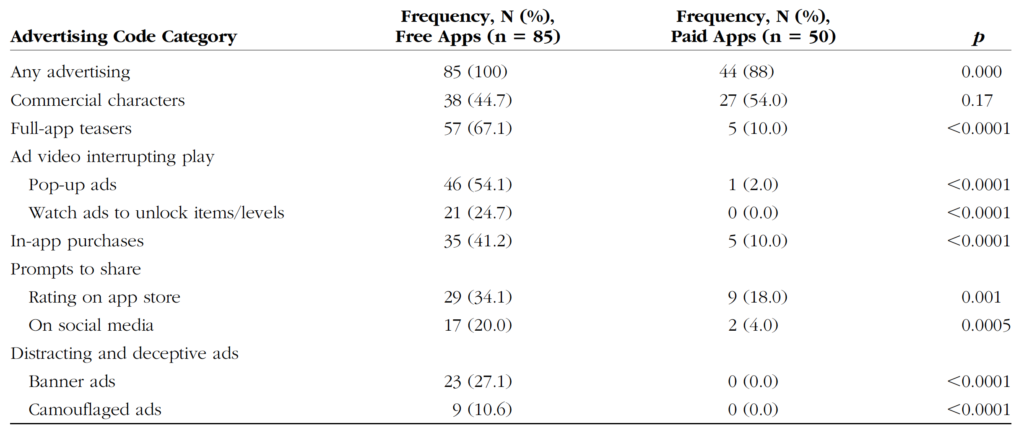
    This review by Wolters Kluwer Health looked at 39 apps that target kids ages 5 and under. They reviewed the different kinds of advertising and manipulation used in the apps to encourage engagement by the young users. Researchers used Android devices and tested the most popular apps in the age category at the time.

    Types of Advertising:

    Commercial Characters – These are apps that are designed around marketing certain characters that your kids may already love. i.e. Daniel Tiger, Mickey Mouse, Bob the Builder, or Hello Kitty.

    App Teasers – Encouragement for kids to unlock the “full version” of the app.

    Ad Videos Interrupting Play – Videos that feature other apps in the marketplace by interrupting your child’s use of the current app and showing videos of gameplay.

    In-App Purchases – Items, levels, or other content that your child can’t use in the app without purchasing them. These may be items that can be used in game, costumes or costume pieces or even in-game currency that can be used to purchase other things in the app.

    Prompts to Share – Encouragement to share the app on social media sites or even just to rate it on the app store.

    Deceptive or Distracting Ads – These ads often trick your child into thinking they are playing another level of the game. Sometimes they look like they are a part of the app your child is using and then open up an app store link when tapped.

    What Parents Should Know

    To get my full thoughts on this research watch the video above. Liking it and sharing with your friends would be super helpful as well. I will say here, though, that it is critical that we as parents understand how these apps are marketing to our children and help our kids understand the difference between something they are playing or learning from and an advertisement. This study also looked at the difference between ads in paid apps vs free apps and educational apps vs entertainment. None of the results are shocking but hopefully, they are a bit eye-opening for parents who allow their kids unsupervised time on screens.


  • NetNanny | Let’s Review Video

    NetNanny | Let’s Review Video

    Let’s Review Video

    Net Nanny features one of the strongest filters available, custom settings, time management, alerts, and much more. In this video, I walk you thought the NetNanny website and we discuss its pros and cons. I share some of the set up woes I experienced with NetNanny but why I think those have been updated. 

    You can learn more at NetNanny.com 

  • New Research Includes Screen Time Limits as Critical for Childrens’ Cognitive Health

    New Research Includes Screen Time Limits as Critical for Childrens’ Cognitive Health

    The elements that create a healthy environment for our children are ever-changing. We want them to understand how to eat right, get exercise, get an education, stay off drugs, and so much more. A new study in Canada has isolated three critical factors for our kids’ health, and not surprisingly, the amount of time they spend on a screen is one of the major players.

    Jeremy J Walsh of the Children’s Hospital of Eastern Ontario published the study that surveyed more than four thousand children ages eight to eleven. They measured cognitive abilities and the amount of time kids spent in active play, sleeping, and on screens. These three factors proved key to high cognitive health in children. The strongest results were from children who slept for 9 to 11 hours per night, spent at least 1 hour per day in active play, and spent less than two hours per day on screens. The study did not differentiate between types of screen time (entertainment/education) but researches say they are continuing their studies in that direction. 

    The report stated that sleep and screen time were the categories most strongly related to cognitive health and that only five percent of children surveyed met the requirements on all three categories. Sadly, nearly one third of the children in the study didn’t meet any of the requirements at all. 

    What Parents Should Know

    You’ve probably heard the fact that many of the developers of the most popular tech products have strict screen time limits for their kids. As do family tech safety experts, myself included. Research is continuing to show that unlimited access to screens can be detrimental to our health and especially to our children’s health. Childhood obesity, mental health, and even suicide rates are rising in the United States, right alongside the number of people who would consider themselves addicted to their screens and to social media. 

    I am looking forward to seeing what the researchers conclude concerning the types of screen time children are having. Smaller studies have shown that young kids learn less when they learn on screens, so I wouldn’t be surprised if cognitive health is affected just as negatively by screen time used for education as it is for entertainment. We will have to wait and see. 

    In the meantime I recommend using Apple’s Screen time, Accountable2You, or UnGlue to monitor the amount of time your child is using their screens. Include the amount of time you know they spend in front of a screen at school as well. Remember that four rounds of Fortnite is about two hours (if you’re pretty good at it) and that game is available on every device your kid has. YouTube videos, social media scrolling, and messaging all add up to two hours of screen time rather quickly too. This is why it is so important to monitor their time spent and even limit it with software or hardware on your wifi and data connection.